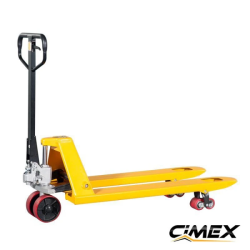


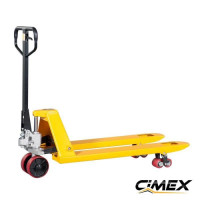
PALLET TRUCKS
Pallet Trucks for Warehouse and Goods Handling
A manual pallet truck moves palletised loads over short distances on suitable level floors. It is a practical way to position goods in a warehouse, production area, stockroom or loading zone without a powered lifting machine. The CIMEX pallet truck category is based on the Bulgarian description of hydraulic pallet trucks and their main parts: a pump, steel forks and wheels. Check the individual product specification before deciding whether a truck suits your pallets, loads and workplace.
Where a Manual Pallet Truck Works Best
Pallet trucks are intended to lift a pallet just enough to clear the floor and roll it to another location. They are useful for moving stock from a delivery area into storage, repositioning materials beside a production line and preparing pallets for dispatch. Their compact, manually operated design can make them convenient in aisles and work areas where the route is clear and the surface is reasonably smooth.
The Bulgarian CIMEX category specifically notes that pallet trucks are suitable for relatively even floors without significant irregularities. Uneven ground, thresholds, steep ramps and damaged flooring can make movement difficult or unsafe, particularly with a heavy load. Before use, assess the full route, including door widths, turns, floor condition and any change in level. A pallet truck is for transporting supported loads close to floor level; it is not a substitute for a forklift or stacker when goods must be placed at height.
Match Capacity and Fork Dimensions to the Pallet
Start with the weight of the loaded pallet. Compare it with the rated capacity on the exact CIMEX product page and allow for the heaviest expected load, including packaging. Never rely on the category's general description as a capacity rating for a specific truck. The pallet must be sound enough to support the load, and its openings must accept the forks without forcing them into damaged boards or blocks.
Fork length and outside width matter as much as capacity. Measure the pallets used at your site and check their entry direction. The forks should support the pallet properly while leaving room to enter and withdraw them. If your operation uses more than one pallet type, check each type before purchasing. Also confirm the truck's overall dimensions and turning space in narrow aisles or small stockrooms.
Hydraulic Pump, Wheels and Handling
The handle operates the hydraulic pump to raise the forks for movement; the release control lowers the load when it reaches its destination. Steering wheels support the rear of the truck, while load rollers under the forks help carry the pallet. Their materials and dimensions affect rolling behaviour on different indoor surfaces. Compare the wheel and roller details listed for the model with your floor, workload and cleaning requirements.
Inspect the pump, handle, forks and wheels before each shift. A bent fork, leaking hydraulic unit or damaged wheel can make a truck hard to control. Keep the travel path free of debris that may block the rollers or cause a sudden stop. Where the site has frequent wet areas, chemical exposure or unusual hygiene requirements, verify the materials and maintenance advice for the specific truck rather than assuming a standard model is suitable.
Move Palletised Loads Safely
Position both forks fully and evenly under the pallet. Raise the load only enough to clear the floor and check that it is stable before travelling. Keep the load balanced and low, move at a speed you can control and watch the route ahead. Take extra care at corners and doorways, and keep hands and feet clear of the wheels, forks and pallet while lowering. Do not carry people on the truck or use it to support a raised load while someone works beneath it.
Use an appropriate method for slopes and loading vehicles. A heavily loaded manual truck may be difficult to stop or steer on an incline, even when it is easy to move on a level warehouse floor. Follow workplace procedures and the manufacturer's instructions for the model. If the route, load or lifting height exceeds what a manual pallet truck can handle safely, choose other suitable handling equipment.
Choose a CIMEX Pallet Truck
Browse the CIMEX pallet truck product to confirm its rated capacity, fork size, wheel configuration and other listed details. Compare those figures with your loaded pallets and the actual travel route. A correctly matched truck can reduce repeated manual carrying and help goods move smoothly between delivery, storage and work areas. Routine inspection and proper operation support reliable day-to-day use.