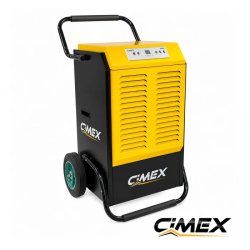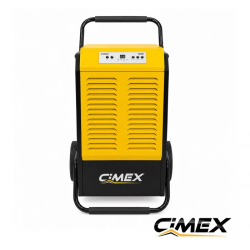
Professional Dehumidifiers for Construction and Commercial Spaces
CIMEX professional dehumidifiers help control excess moisture in construction sites, renovated buildings, warehouses, workshops, archives, sports facilities, offices and temporary workspaces. They are also useful during controlled drying after leaks or flooding. By removing water vapour from the air, a correctly selected dehumidifier can support drying work, reduce condensation and help protect materials, equipment and stored goods from moisture-related damage.
Construction moisture should not be underestimated. Screeds, plaster, filler, paint and other wet trades release moisture as they cure. If humidity remains high, later stages such as flooring, coating or decoration may be delayed or compromised. A dehumidifier supports the process, but it does not replace correct ventilation, heating, moisture testing or the curing instructions supplied by the material manufacturer.
Where professional dehumidifiers are used
- Construction and renovation: controlled drying of suitable rooms after plastering, screeding, painting or water ingress.
- Flood and leak recovery: removal of airborne moisture.
- Warehouses and archives: management of humidity where stock, documents or equipment may be affected by condensation.
- Workshops and industrial areas: reduction of damp conditions that can contribute to corrosion and uncomfortable working environments.
- Commercial premises: humidity control in offices, halls, changing rooms and other occupied or temporary spaces.
The cause of moisture must be identified first. A dehumidifier cannot repair a leaking roof, damaged pipe, failed waterproofing layer or rising damp. Resolve active water entry where possible and obtain specialist advice when structural materials or hidden cavities may remain wet.
How a condensing dehumidifier works
Many portable professional units draw humid air across a cooled surface, causing water vapour to condense. The collected water enters an internal tank or leaves through a continuous drain connection. Drier air is then returned to the room. Performance depends on temperature and relative humidity; the stated litres per day are normally measured under defined test conditions and should not be interpreted as guaranteed output in every room.
How to choose the right dehumidifier
- Extraction capacity: compare the rated moisture removal and the conditions under which it was measured.
- Operating range: confirm the permitted temperature and relative-humidity range for the site.
- Airflow: higher airflow can improve circulation, but room layout and closed doors can limit distribution.
- Drainage: decide whether the internal tank is practical or whether continuous drainage is needed for longer operation.
- Tank capacity: a larger tank may reduce emptying frequency, but the machine must still stop or warn safely when full.
- Power supply: verify voltage, consumption, cable routing and available circuit capacity.
- Noise and mobility: consider occupied areas, stairs, vehicle loading, handle design, wheels and machine weight.
CIMEX models differ in capacity and construction. For example, product data may state nominal extraction rates such as 50 or 90 litres per day for particular models, but these figures apply only to the specified test conditions. Use the individual listing for accurate model information.
Getting effective drying performance
Close external doors and windows when the drying plan requires a controlled space, while maintaining any ventilation needed for safety. Position the unit with adequate clearance around the air inlet and outlet. For larger or divided areas, use air movers or multiple dehumidifiers only where the site plan and equipment instructions support this arrangement.
Measure progress rather than relying on how the room feels. A hygrometer can track relative humidity, while suitable moisture meters or professional testing methods may be required for screed, timber or structural materials. Drying too quickly can also damage some finishes, so follow the relevant trade guidance.
Safe operation and maintenance
Place the machine upright on a stable surface. Inspect the plug, cable, filter, tank and drain hose before use. Do not obstruct airflow, expose the unit to unapproved temperatures or operate it where flammable vapours may be present. After transport, follow the manufacturer’s required settling time before switching on.
Clean the air filter at the intervals stated in the manual, empty and rinse the collection tank, and check that continuous drainage runs downhill without kinks or leaks. Ice formation, unusual noise, repeated shutdowns or reduced water collection may indicate unsuitable conditions or a need for service.
Frequently asked questions
How many litres per day do I need?
It depends on room volume, temperature, humidity, moisture load, air exchange and drying target. Nominal capacity alone is not enough for accurate sizing.
Should windows stay open?
Usually not during controlled dehumidification, because outside humid air can continually enter. However, ventilation requirements for safety and specific materials take priority.
Can a dehumidifier solve mould or rising damp?
It may reduce humidity, but the moisture source and any contamination must be assessed and treated separately.
Explore CIMEX dehumidifiers by extraction capacity, airflow, operating range, drainage and site requirements. Contact CIMEX with the room size, temperature, moisture source and intended use for help comparing suitable models.
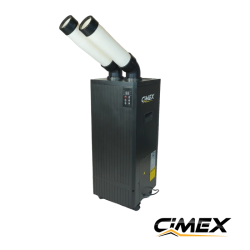
Professional Dehumidifiers for Construction and Commercial Spaces
CIMEX professional dehumidifiers help control excess moisture in construction sites, renovated buildings, warehouses, workshops, archives, sports facilities, offices and temporary workspaces. They are also useful during controlled drying after leaks or flooding. By removing water vapour from the air, a correctly selected dehumidifier can support drying work, reduce condensation and help protect materials, equipment and stored goods from moisture-related damage.
Construction moisture should not be underestimated. Screeds, plaster, filler, paint and other wet trades release moisture as they cure. If humidity remains high, later stages such as flooring, coating or decoration may be delayed or compromised. A dehumidifier supports the process, but it does not replace correct ventilation, heating, moisture testing or the curing instructions supplied by the material manufacturer.
Where professional dehumidifiers are used
- Construction and renovation: controlled drying of suitable rooms after plastering, screeding, painting or water ingress.
- Flood and leak recovery: removal of airborne moisture as part of a planned restoration process.
- Warehouses and archives: management of humidity where stock, documents or equipment may be affected by condensation.
- Workshops and industrial areas: reduction of damp conditions that can contribute to corrosion and uncomfortable working environments.
- Commercial premises: humidity control in offices, halls, changing rooms and other occupied or temporary spaces.
The cause of moisture must be identified first. A dehumidifier cannot repair a leaking roof, damaged pipe, failed waterproofing layer or rising damp. Resolve active water entry where possible and obtain specialist advice when structural materials or hidden cavities may remain wet.
How a condensing dehumidifier works
Many portable professional units draw humid air across a cooled surface, causing water vapour to condense. The collected water enters an internal tank or leaves through a continuous drain connection where provided. Drier air is then returned to the room. Performance depends on temperature and relative humidity; the stated litres per day are normally measured under defined test conditions and should not be interpreted as guaranteed output in every room.
How to choose the right dehumidifier
- Extraction capacity: compare the rated moisture removal and the conditions under which it was measured.
- Operating range: confirm the permitted temperature and relative-humidity range for the site.
- Airflow: higher airflow can improve circulation, but room layout and closed doors can limit distribution.
- Drainage: decide whether the internal tank is practical or whether continuous drainage is needed for longer operation.
- Tank capacity: a larger tank may reduce emptying frequency, but the machine must still stop or warn safely when full.
- Power supply: verify voltage, consumption, cable routing and available circuit capacity.
- Noise and mobility: consider occupied areas, stairs, vehicle loading, handle design, wheels and machine weight.
CIMEX models differ in capacity and construction. For example, product data may state nominal extraction rates such as 50 or 90 litres per day for particular models, but these figures apply only to the specified test conditions. Use the individual listing for accurate model information.
Getting effective drying performance
Close external doors and windows when the drying plan requires a controlled space, while maintaining any ventilation needed for safety. Position the unit with adequate clearance around the air inlet and outlet. For larger or divided areas, use air movers or multiple dehumidifiers only where the site plan and equipment instructions support this arrangement.
Measure progress rather than relying on how the room feels. A hygrometer can track relative humidity, while suitable moisture meters or professional testing methods may be required for screed, timber or structural materials. Drying too quickly can also damage some finishes, so follow the relevant trade guidance.
Safe operation and maintenance
Place the machine upright on a stable surface. Inspect the plug, cable, filter, tank and drain hose before use. Do not obstruct airflow, expose the unit to unapproved temperatures or operate it where flammable vapours may be present. After transport, follow the manufacturer’s required settling time before switching on.
Clean the air filter at the intervals stated in the manual, empty and rinse the collection tank, and check that continuous drainage runs downhill without kinks or leaks. Ice formation, unusual noise, repeated shutdowns or reduced water collection may indicate unsuitable conditions or a need for service.
Frequently asked questions
How many litres per day do I need?
It depends on room volume, temperature, humidity, moisture load, air exchange and drying target. Nominal capacity alone is not enough for accurate sizing.
Should windows stay open?
Usually not during controlled dehumidification, because outside humid air can continually enter. However, ventilation requirements for safety and specific materials take priority.
Can a dehumidifier solve mould or rising damp?
It may reduce humidity, but the moisture source and any contamination must be assessed and treated separately.
Explore CIMEX dehumidifiers by extraction capacity, airflow, operating range, drainage and site requirements. Contact CIMEX with the room size, temperature, moisture source and intended use for help comparing suitable models.
Professional Dehumidifiers for Construction and Commercial Spaces
CIMEX professional dehumidifiers provide controlled moisture removal in buildings where, storage areas, workshops, archives, sports facilities, offices and rooms affected by leaks or flooding. On construction and renovation sites, reducing excess humidity can support the drying of plaster, screed, filler and painted surfaces before the next finishing stage.
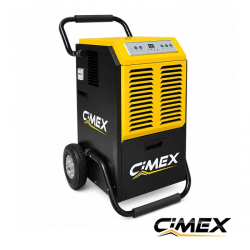
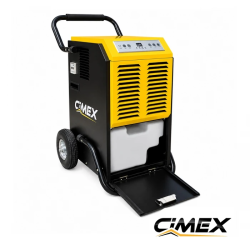
The CIMEX range includes mobile dehumidifiers for everyday professional use. The DH50 and DH90 models are rated at up to 50 and 90 litres per day respectively under their specified test conditions. Actual water extraction depends on room temperature, relative humidity, airflow and the operating environment.
Typical Applications for a Mobile Dehumidifier
- Drying rooms after plastering, screeding, filling and painting
- Moisture control before installing parquet or laminate flooring
- Supporting recovery after water leaks and flooding
- Reducing condensation risk in warehouses, archives and technical rooms
- Managing humidity in workshops, offices, gyms and other commercial spaces
How to Choose a Dehumidifier
Compare extraction capacity in litres per day, operating temperature and humidity range, airflow, power consumption, noise level, condensate-tank capacity and continuous-drainage options. Select capacity according to the room volume, moisture load and required drying time rather than using floor area alone.
For effective operation, keep the working area suitably enclosed, maintain clear airflow around the machine and follow the instructions for drainage, filter cleaning and storage. Explore CIMEX dehumidifiers and compare the specifications of each model for professional drying and humidity control.
-250x250.png)
-250x250.jpeg)
-250x250.jpeg)