


Pipe Bending Machines for Steel, Copper and Installation Tube
Pipe bending machines form a controlled curve without cutting a tube into separate sections and joining an elbow. The CIMEX HPB range covers two distinct jobs: portable manual benders for smaller, softer tube and pneumo-hydraulic benders for thicker-walled steel pipe. Choosing the correct machine depends on the tube material, outside diameter, wall thickness, required bend angle and working space. The category includes manual HPB-22 and HPB-25 tools alongside HPB-12 and HPB-2 steel-pipe benders.
Manual pipe benders for smaller tubes
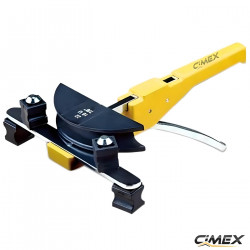
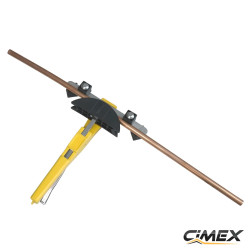
For plumbing, heating, air conditioning and refrigeration installation, a compact manual tube bender can help route copper or other compatible soft tube neatly around a corner. The CIMEX HPB-22 is listed for soft copper, coated soft copper and aluminium tube in the 6–22 mm range; its individual listing also describes compatible multilayer tube under stated conditions. Interchangeable bending forms support different sizes, while the ratchet mechanism makes controlled movement practical in confined areas. Check the product specification for the permitted wall thickness and the form supplied for the exact tube you will use.
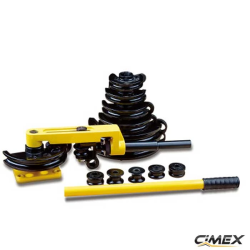
The HPB-25 manual kit is listed for 10–25 mm tube and several materials, including soft steel, stainless steel, copper and aluminium where the product specification permits them. A material name alone does not establish that every grade or temper will bend successfully. Harder tube, thicker walls and a tighter bend radius increase the force required and the risk of flattening. Match the die to the measured outside diameter and consult the product instructions for material and wall-thickness limits. Manual benders are suited to site installation and smaller sections; they do not replace a hydraulic machine for the heavier steel-pipe sizes in this category.
Pneumo-hydraulic benders for steel pipe
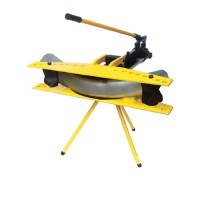
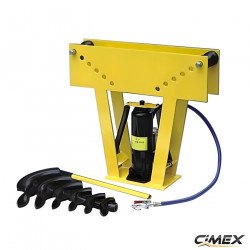
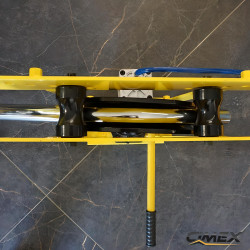
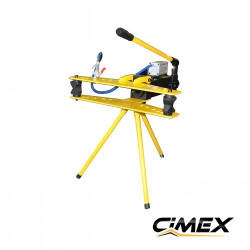
The CIMEX HPB-12 and HPB-2 are designed for cold bending compatible steel pipe, with their listings describing nominal sizes from ½ to 2 inches and bend angles up to 90°. For compatible thick-walled steel pipe, the category information describes approximately 2.75–4.5 mm wall thickness and bending forms for ½, ¾, 1, 1¼, 1½ and 2 inches. Confirm the supplied forms and capacity for the individual model before ordering: the nominal pipe designation, actual outside diameter, wall thickness and material grade all matter. The same die should not be assumed to fit an unrelated tube standard simply because its nominal size looks similar.
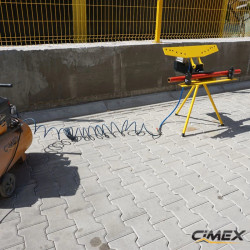
These models use a hydraulic ram to apply bending force. Where a model has the appropriate pneumatic connection, compressed air can actuate the hydraulic system and reduce repeated manual pumping. Check the required air supply, hose connection and operating instructions for the machine. The pneumatic feature is an alternative way to drive the hydraulic ram; it does not make the bender suitable for every pipe material or eliminate the need for correctly fitted supports and forms.
Choose a machine for the bend and job site
Begin with a drawing or a measured routing plan. Record tube material, actual diameter, wall thickness, required angle, bend radius and the straight length available on each side of the bend. Check that the selected form supports those dimensions and that the finished bend will fit the installation. For repeated bends, mark a reference line and make a test piece to account for springback. Different materials recover by different amounts after the force is released; measure the first result before processing the rest of a batch.
Manual benders are usually easier to carry between installations and to position near existing services. A hydraulic steel-pipe bender needs more stable space for its frame, supports and pipe length. Also consider how the bent pipe will be cut, deburred and joined. Bending avoids some fittings but does not remove the need to follow the applicable installation method, pressure rating and trade requirements. Pipe bending and pipe threading are separate operations: select a pipe threading machine if the job needs threaded ends.
Work safely and protect the finished pipe
Inspect the frame, dies, pins, hydraulic connections and hose before use. Keep hands clear of the moving form and support points; secure the pipe so it cannot roll or spring out unexpectedly. Use the specified form and support positions, apply force gradually and stop if the tube wrinkles, flattens excessively or cracks. Release pressure according to the manual before removing the workpiece. Wear eye protection and handle freshly cut edges with care. After work, clean the forms and check the hydraulic system for leakage or damage. A pipe that has been kinked or visibly weakened should not be installed in a pressure system without an appropriate inspection and approval.
Compare the four CIMEX pipe bending products by tube material, permitted size, drive method, die set and site portability. Use the individual product data to confirm the final match for your project.
-250x250.png "Manual Pipe Bending Machine 10-25 mm – CIMEX HPB-25")